Menu


Teams are complex and what we see on the surface rarely tells the whole story. Whether performance is falling short, the organisation is entering a new stage of growth or an already capable team wants to become stronger, understanding what is really shaping performance creates a stronger basis for what follows.
The Strategic Team Review is grounded in systems thinking, focusing on underlying patterns and causes rather than surface-level observations. It views the organisation as an interconnected system, where performance is shaped by how its different elements interact.
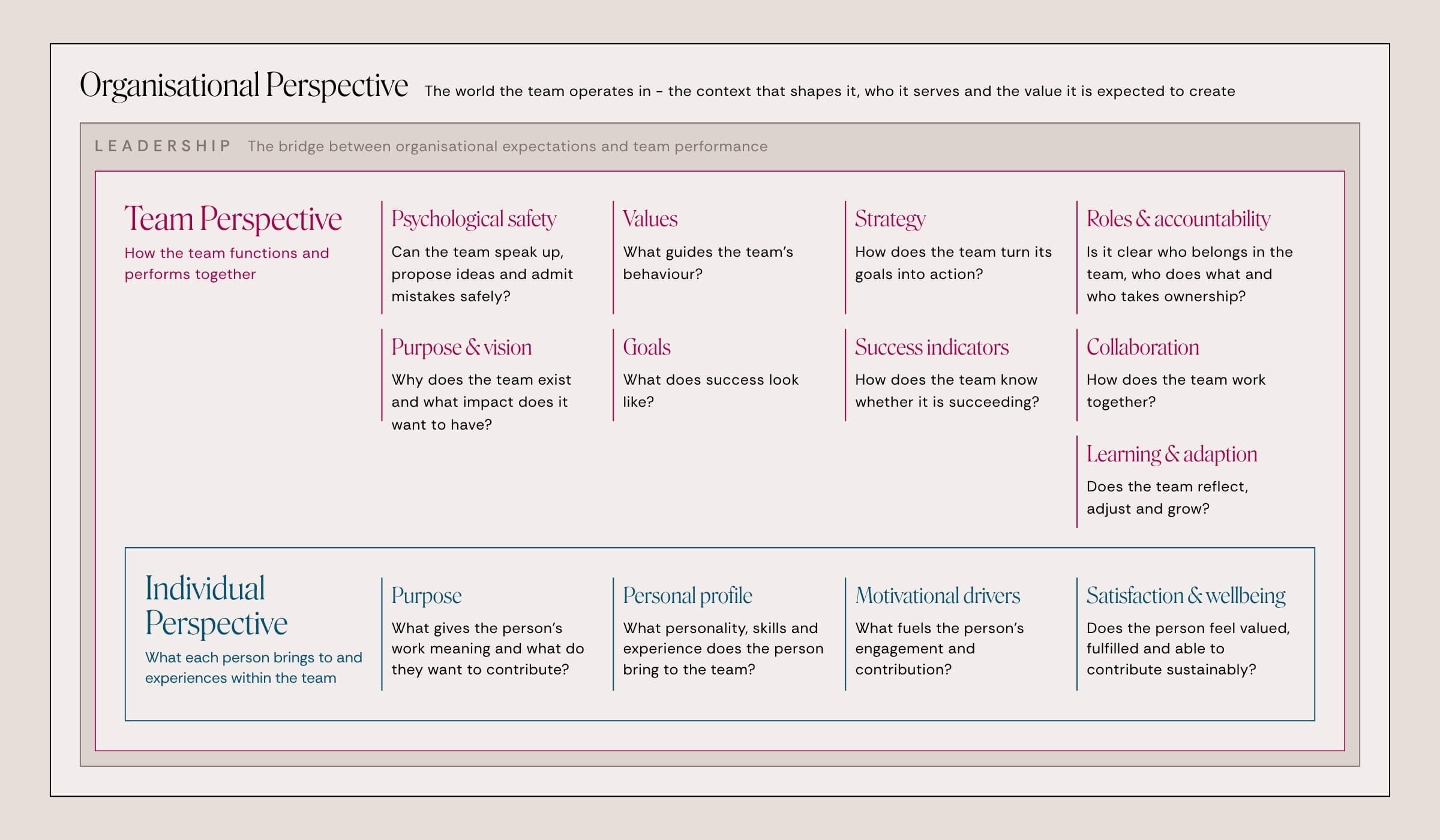
The review explores the team through three interconnected perspectives – organisational, team and individual – recognising that performance is shaped by how these different levels interact.

A conversation with the leader to understand the organisation's context, direction and priorities
Confidential individual conversations with team members, complemented by other relevant assessment methods
Bringing together different perspectives to identify the patterns, relationships and conditions shaping team performance
A leadership discussion focused on the findings, their implications and the decisions that deserve attention
The value of a Strategic Team Review lies not only in deeper understanding, but in what that understanding makes possible. The findings are brought together into a clear view of the patterns shaping performance, the areas that deserve attention and the decisions that matter most.
What follows is determined by what the organisation actually needs. This may involve changes to structures, ways of working or other organisational conditions and, where relevant, executive coaching, team coaching or longer-term advisory support.
Today’s leadership landscape is more complex than ever. Beyond technological, economic and geopolitical shifts, expectations towards leaders have fundamentally changed. Leading effectively now requires continuous reflection, adaptation and conscious choice.
The coaching partnership begins with a clear understanding of the leader's goals, challenges and context. Through reflective inquiry, thinking patterns, decision-making habits and leadership behaviours are explored — surfacing what may be limiting effectiveness and supporting more intentional leadership choices.
Where valuable, coaching can be complemented by personality assessment and stakeholder input to deepen self-awareness and provide a broader perspective on leadership strengths and development areas. If appropriate, coaching may also include advisory elements — offering strategic insight, leadership frameworks and real-time reflection on complex decisions.
The exact approach, whether pure coaching or a coaching-advisory combination, as well as the frequency and duration of sessions, is tailored to the leader's context and objectives. Coaching creates structure and accountability, but meaningful results require commitment and time. The return is tangible — clearer thinking, stronger leadership presence and measurable impact on performance and results.
individual semi-structured interviews with team members
individual semi-structured interviews with team members
individual semi-structured interviews with team members
individual semi-structured interviews with team members
Regular reflection strengthens a leader’s ability to navigate complexity, inspire others and act with intention. Executive coaching supports leaders in thinking differently, thinking bigger and translating that thinking into meaningful impact where it matters most.
A high-performing team is characterised by shared purpose, clear goals, open communication, psychological safety, strong collaboration and mutual accountability for outcomes. In many organisations, the challenge is not individual capability or motivation, but how the team functions as a system – how effectively it aligns, collaborates and adapts.
Team coaching focuses on teams improving how they work together to achieve better and more sustainable results. Team coaching typically takes place over a series of sessions, allowing time for reflection, experimentation and behavioural change. The coach does not provide solutions and rather facilitates the process through which the team develops its own insights and ways of working.
clarify the team’s purpose and identity
align goals and strategic direction
define ways of working, roles and responsibilities
understand and improve key team processes
navigate growth, change or increased complexity
strengthen collaboration and collective resilience
increase ownership and shared accountability
unlock creativity and untapped potential
address complex or systemic challenges
track and reflect on progress
My role as a team coach is to create a space where teams can step back from day-to-day execution, reflecton how they operate and address patterns that either support or limit performance. As an external partner, I bring an independent perspective, unaffected by internal dynamics. My approach is grounded in systems thinking, recognising that team effectiveness is shaped not only within the team, but also by the wider organisational context.
Team coaching is not generic team-building. It is one of the most impactful forms of team development, with measurable effects on team processes such as reflexivity, creativity, accountability and autonomy, as well as on performance, productivity and overall impact. Ultimately, it enables a team to achieve what would not be possible as a group of individuals.
This approach is grounded in systems thinking – the understanding that every team exists within a wider network of other teams, functions, customers, partners and authorities. Each of these groups has expectations about how the team operates and what it delivers. If these expectations are not considered, they will still shape the outcome, whether the team is aware of them or not.
Strategic Team Advisory is designed for leaders who want an ongoing thinking partner: someone who knows their team, understands their context and can be brought into important conversations and decisions, not just scheduled sessions.
This is not a fixed programme. It is a defined partnership with an agreed scope, regular rhythm and clear purpose – one that goes deeper than a one-off engagement because depth requires time.
team performance diagnostics and follow-up assessment
executive and team coaching
facilitative interventions
advisory input on leadership and team matters
strategic reflection and a sounding board for the leader
The aim is not dependency, but growing capability. The engagement has a defined scope and horizon, and success means the team continues to develop and perform long after the engagement ends.
What makes this different from individual services is continuity. Over time, patterns become visible that a single engagement cannot reveal. Trust deepens. The work becomes more honest, more precise and more impactful because the foundation is already in place.